NGS for Challenging Environmental Samples: Feces, Soil, and Water
The Real Question Isn't "Can You Extract DNA?"
For next-generation sequencing (NGS), the central question is not simply whether DNA can be extracted, but whether the extracted DNA accurately represents the original community.
NGS on feces, soil, and water faces common hurdles: variable biomass, inhibitors, degradation, and strong protocol-dependent bias, especially in DNA extraction and preservation [1]. A good NGS workflow starts with the biological reality of the sample rather than the sequencing platform. In practice, that means matching collection, transport, and extraction to the expected biomass level and inhibitor load before thinking about library prep. A clear, fit - for - purpose workflow from field to library prep supports more robust, comparable data.
Three Sample Types, Three Different Problems
-
Feces - Usually rich in biomass, but highly sensitive to how it's stored and preserved.
-
Soil - Chemically and physically complex, with strong inhibitors and wide variation across small distances.
-
Water - Often low in biomass, requiring careful concentration and strict contamination control [2, 3].
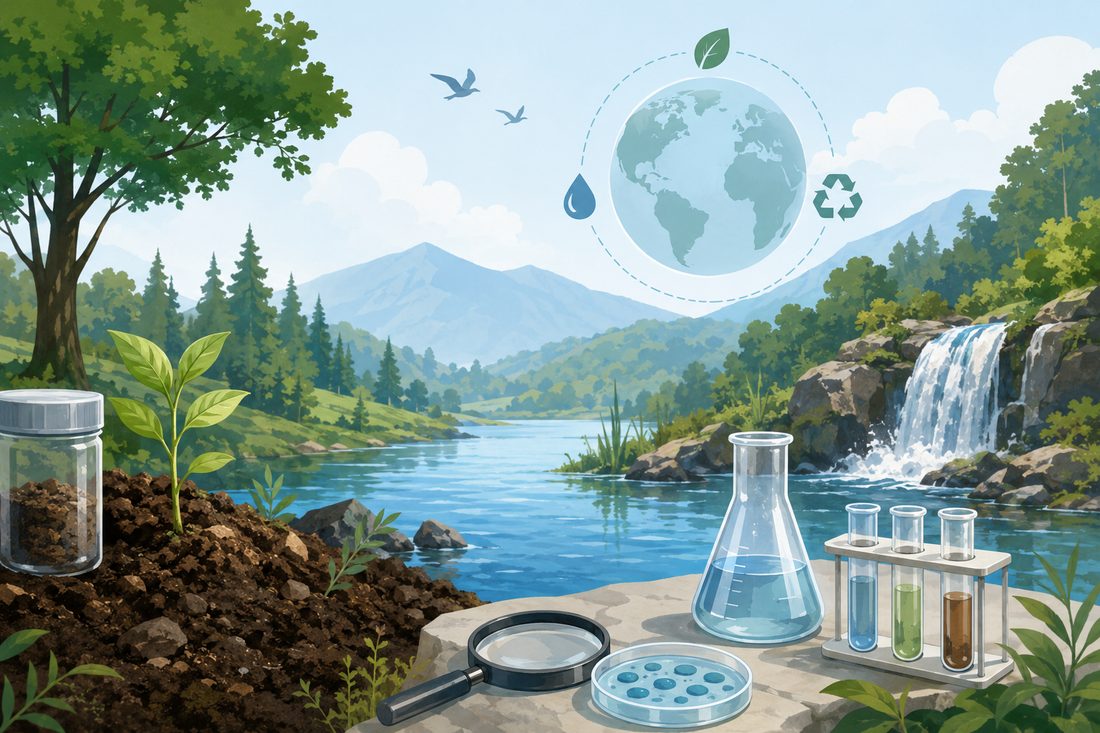
What these samples share is that a generic, one-size-fits-all workflow will fail at least one of them. A protocol optimized for feces will typically underperform on inhibitor-heavy soil; a workflow calibrated for high-biomass samples will miss rare taxa in dilute water. For NGS specifically, these failures are compounding. Poor DNA quality at extraction propagates through library prep, affects sequencing depth distribution, and ultimately biases diversity estimates and functional inferences.
NGS Goals
The goal of NGS depends on the sample type. In feces, researchers often want to profile the gut microbiome, study antibiotic resistance genes, or link microbial patterns to host traits [1]. In soil, the focus is usually on microbial diversity, ecosystem function, land-use effects, and functional genes related to nutrient cycling. In water, NGS is often used to detect pathogens, indicator organisms, or antibiotic resistance genes.[5] The following table summarizes the key goals and challenges per sample type:
|
Sample type |
NGS Goal |
Main challenge |
Issue |
Recommended Workflow Step |
|---|---|---|---|---|
|
Feces |
Gut microbiome profiling, resistome analysis, phenotype association |
Storage sensitivity |
Community shifts before extraction [4] |
Immediate freezing or validated preservative, consistent handling |
|
Soil |
Microbial diversity, ecosystem function, land-use impacts, functional genes |
Inhibitors and heterogeneity |
Poor PCR performance, uneven recovery, inconsistent profiles |
Careful sampling design, inhibitor removal, optimized extraction |
|
Water |
Pathogen/indicator detection, ARG monitoring |
Low biomass and contamination |
Background DNA overwhelms signal [3] |
Filtration or concentration, blanks, strict clean workflow |
Building a Workflow That Fits

Each sample type requires specific attention at three stages: collection, nucleic acid isolation, and QC.
The choices made at each step carry forward into sequencing quality and the reliability of downstream analysis.
1. Sample Collection
Collection strategy varies considerably by matrix. Water samples from low-biomass sources such as drinking water typically require filtration of large volumes, often 100 to 2,000 liters to concentrate enough biomass for detection [3]. Soil sampling needs to account for depth, since microbial diversity and functional potential shift meaningfully across intervals like 3 cm, 12 cm, and 30 cm [4]. Fecal samples for microbiota analysis should be collected using standardized procedures with documentation of key factors that influence microbial composition, such as age, antibiotic use, medications, diet, and lifestyle [6]. Across all three matrices, preserving DNA integrity from the moment of collection is key. Immediate freezing at −80°C is preferred, though validated preservation solutions can stabilize samples during transport when freezing isn't possible.
Explore preservation solutions designed for environmental NGS workflows →
2. Sample Homogenization
Sample homogenization is a critical first step for environmental samples, where matrix complexity can limit DNA recovery and bias downstream results. A robust mechanical disruption step helps improve cell lysis, reduce sample-to-sample variability, and support more representative downstream NGS results.For feces, soil, and water-derived filters, a practical unified setting is FastPrep-24 5G at 5–6 m/s for 30–40 seconds, using a sample-appropriate lysing matrix. Different sample types require different bead compositions, so the matrix should be selected based on the target material and the toughness of the sample.FastPrep-24 5G offers rapid, reproducible bead-beating for a wide range of environmental samples, improving DNA release from difficult or uneven matrices and helping standardize the workflow.
See how the FastPrep-24 5G and Lysing Matrix E handle feces, soil, and water samples →
3. Nucleic Acid Isolation
The goal is high-quality, pure nucleic acids.
Protocols may require troubleshooting and adjustment based on the target (e.g., bacteria vs. viruses) and the sample source [5].
For shotgun metagenomics, extraction methods must yield HMW DNA (ideally fragments of 15,000 to 20,000 bp).
These fragments are later broken into constant-sized pieces for library preparation; if the DNA is already degraded, it can bias the diversity observed in the results.
Browse extraction kits validated for environmental metagenomics →
4. Sample Quality Control
Quantitation matters here. A Qubit fluorometer is well suited for sensitive DNA quantitation, while an Agilent Bioanalyzer or TapeStation can verify fragment size before sequencing [5].
Sequencing Selection
-
16S rRNA gene sequencing is best for identifying bacteria and archaea, usually down to the genus level. Full-length 16S sequencing with long-read platforms such as PacBio or Oxford Nanopore can improve taxonomic resolution for closely related species [2].
-
ITS sequencing targets fungi and other eukaryotes. The UNITE database is commonly used for classification, while FUNGuild or FungalTraits can help predict function.
-
Shotgun metagenomics is the best choice when you want strain-level resolution or want to study functional pathways, such as carbon and nitrogen cycling.
Regardless of the sequencing strategy chosen, input DNA quality remains the common bottleneck. The sequencing platform does not correct what was lost or damaged upstream; it amplifies the consequences. Selecting the right preservation method and extraction kit for your sample matrix is the foundation on which reliable sequencing data is built.
Ready to achieve the same sequencing confidence in your NGS studies?
Explore the MP Biomedicals' full range of environmental solutionsReference
-
Unno, T., Staley, C., Brown, C. M., Han, D., Sadowsky, M. J., & Hur, H. G. (2018). Fecal pollution: new trends and challenges in microbial source tracking using next-generation sequencing. Environmental microbiology, 20 (9), 3132–3140. https://doi.org/10.1111/1462-2920.14281
-
Reznikova DA, Barannikova MV, Shnakhova LM, Mitkin NA and Vatlin AA (2026) Next-generation sequencing approaches for soil microbiome research. Front. Soil Sci. 5:1706999. doi: 10.3389/fsoil.2025.1706999
-
Tan B, Ng C, Nshimyimana JP, Loh LL, Gin KY-H and Thompson JR (2015) Next-generation sequencing (NGS) for assessment of microbial water quality: current progress, challenges, and future opportunities. Front. Microbiol. 6:1027. doi: 10.3389/fmicb.2015.010274.
-
Técher, D., Martinez-Chois, C., D’Innocenzo, M., Laval-Gilly, P., Bennasroune, A., Foucaud, L., & Falla, J. (2010). Novel perspectives to purify genomic DNA from high humic acid content and contaminated soils. Separation and Purification Technology, 75(1), 81–86. https://doi.org/10.1016/j.seppur.2010.07.014
-
Next Generation Sequencing Implementation Guide. (2016). https://aphl.org/docs/default-source/technical/ID-NGS-Implementation-Guide102016.pdf
-
Thomas, V., Clark, J., & Doré, J. (2015). Fecal microbiota analysis: an overview of sample collection methods and sequencing strategies. Future Microbiology, 10(9), 1485–1504. https://doi.org/10.2217/fmb.15.87