
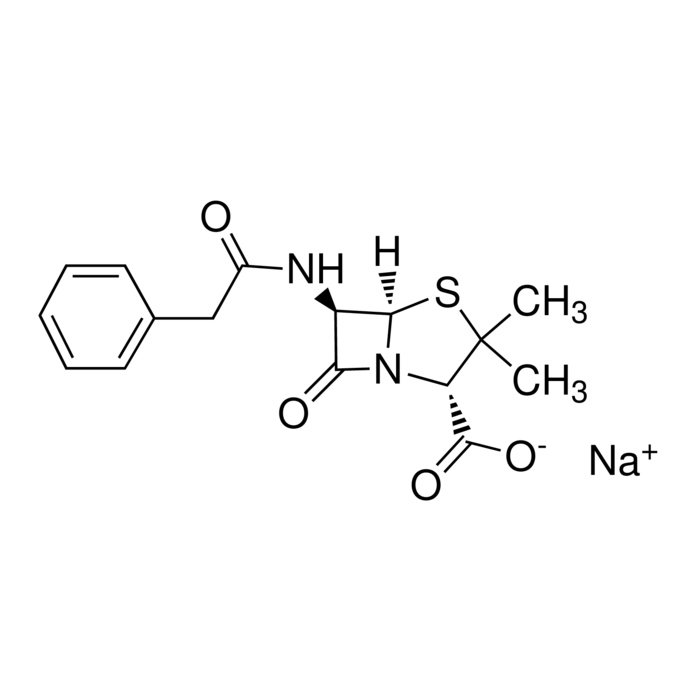
Penicillin G Sodium Salt, cell culture grade
SKU: 02194537-CF
MP Biomedicals Penicillin G Sodium Salt, Cell Culture Grade, is a water-soluble benzylpenicillin sodium powder used as a research antibiotic. Penicillin G acts by inhibiting bacterial cell-wall peptidoglycan cross-linking through penicillin-binding proteins. It is commonly associated with activity against susceptible Gram-positive bacteria; effective control depends on the microorganism and its susceptibility. It should not be presented as universally active against all bacterial species or as a substitute for aseptic technique. Researchers can prepare an antibiotic stock solution for use in appropriate laboratory media or antimicrobial studies. The current MP Biomedicals product specifications list >1,500 U/mg potency and advise sterile filtration of prepared solutions. Concentration, storage after reconstitution and compatibility should be determined by the validated experiment and current product documents.
Application Notes
Penicillin G is a narrow spectrum antibiotic derived from Streptococcus pneumoniae. It has been used to study the diagnostic and therapeutic implications of gentamicin-resistant Enterococcus faecalis sequence type 6 with reduced penicillin susceptibility and in cell culture both alone and combined with streptomycin and other antibiotics.
Usage Statement
Unless specified otherwise, MP Biomedical's products are for research or further manufacturing use only, not for direct human use. For more information, please contact our customer service department.
Key Applications
Antibiotic
| SKU | 02194537-CF |
| Alternate Names | Benzylpenicillin sodium salt |
| Applications | Antibiotic |
| Application Notes | Penicillin G is a narrow spectrum antibiotic derived from Streptococcus pneumoniae. It has been used to study the diagnostic and therapeutic implications of gentamicin-resistant Enterococcus faecalis sequence type 6 with reduced penicillin susceptibility and in cell culture both alone and combined with streptomycin and other antibiotics. |
| Base Catalog Number | 194537 |
| Beilstein Registry Number | 3834217 |
| Biochemical Physiological Actions | Mode of Action: The β-lactam moiety (functional group) of penicillin G binds to the enzyme (DD-transpeptidase) that links the peptidoglycan molecules in bacteria. The enzymes that hydrolyze the peptidoglycan cross-links continue to function, which weakens the cell wall of the bacterium, it causes cytolysis(death due to osmotic pressure) in Bactria. Antimicrobial spectrum: Gram-positive bacteria. |
| CAS # | 69-57-8 |
| Density | 1.41 (NTP, 1992) |
| EC Number | 200-710-2 |
| Format | Powder |
| Grade | Cell Culture Grade |
| Hazard Statements | H317-H334 |
| Melting Point | 408 to 414° F (decomposes) (NTP, 1992) |
| Molecular Formula | C16H17N2O4SNa |
| Molecular Weight | 356.40 |
| Personal Protective Equipment | Dust mask, Eyeshields, Faceshields, Gloves |
| Potency | >1500 u/mg |
| RTECS Number | XH9800000 |
| Safety Symbol | GHS08 |
| Solubility | 50 to 100 mg/mL at 77° F (NTP, 1992) |
| Sterilization of Solutions | Solutions should be filter sterilized. Store in small aliquots at appropriate temperature until use. |
| Typical Working Concentration | For Gram Positive Bacteria=105 U/L |
| Usage Statement | Unless specified otherwise, MP Biomedical's products are for research or further manufacturing use only, not for direct human use. For more information, please contact our customer service department. |
Frequently Asked Questions
Q1. What is Penicillin G Sodium Salt, Cell Culture Grade?
It is a powdered benzylpenicillin sodium β-lactam antibiotic used in laboratory cell culture and antibacterial research. MP Biomedicals lists it under Base Catalog #194537 (parent SKU 02194537-CF).
Q2. How does Penicillin G Sodium Salt work?
Penicillin G binds to penicillin-binding proteins involved in bacterial peptidoglycan cross-linking. In susceptible bacteria, this interferes with cell-wall synthesis and can lead to bacterial cell death.
Q3. What is Penicillin G Sodium Salt used for in cell culture?
It may be used as an antibiotic supplement in suitable research culture media or as part of a validated contamination-control protocol. It does not replace aseptic technique and will not prevent every type of contamination.
Q4. Is Penicillin G Sodium Salt the same as benzylpenicillin sodium?
Yes. Benzylpenicillin sodium salt is another name for Penicillin G Sodium Salt. The MP Biomedicals product is supplied as a powder.
Q5. What is the potency of MP Biomedicals Penicillin G Sodium Salt?
The official product page lists potency above 1,500 U/mg. Check the lot-specific Certificate of Analysis for the actual measured activity and the approved release specification.
Q6. Is Penicillin G Sodium Salt active against Gram-positive and Gram-negative bacteria?
Penicillin G is primarily associated with activity against susceptible Gram-positive organisms. Susceptibility varies among bacterial species and strains, so it should not be described as a universal broad-spectrum antibiotic.
Q7. Can Penicillin G Sodium Salt be combined with streptomycin?
Penicillin and streptomycin are commonly combined in suitable research cell culture protocols. MP Biomedicals also supplies premixed Penicillin–Streptomycin solutions; check the final concentrations and culture compatibility.
Q8. What is the difference between Penicillin G Sodium Salt powder and Pen-Strep solution?
Penicillin G Sodium Salt is one antibiotic supplied as a powder. Pen-Strep is a premixed liquid formulation containing penicillin plus streptomycin, with product-specific concentration and packaging.
Q9. How should Penicillin G Sodium Salt stock solutions be prepared?
Follow the current manufacturer information and your validated laboratory SOP. MP Biomedicals advises sterile filtration of prepared solutions and appropriate storage in aliquots; do not assume the dry powder is ready for aseptic use.
Q10. What is the recommended working concentration for cell culture?
There is no universal concentration suitable for every cell type and research protocol. Choose a working concentration based on the intended application, susceptibility, SOP and any relevant manufacturer guidance.
Q11. How should Penicillin G Sodium Salt be stored?
A recent MP Biomedicals lot CoA for Catalog #194537 specifies 2–8 °C protected from light. Follow the current product label and lot CoA; prepared solutions may require different conditions.
Q12. Is this product sterile, endotoxin-free or suitable for clinical use?
Do not assume these attributes. Review the applicable lot-specific CoA and the current product documents. MP Biomedicals lists this product for research or further manufacturing use, not for direct human use.
Q13. What is the difference between Penicillin G Sodium Salt and Penicillin G Potassium Salt?
They contain the same benzylpenicillin active moiety but have different counterions and corresponding product identifiers. Use the salt form specified by the research protocol and confirm its product documentation.
Q14. Where can I find a Certificate of Analysis or Safety Data Sheet?
Use the official MP Biomedicals product page to search by lot number and access the current CoA, technical information and regional Safety Data Sheet.

 Powered by Bioz