
Product Description
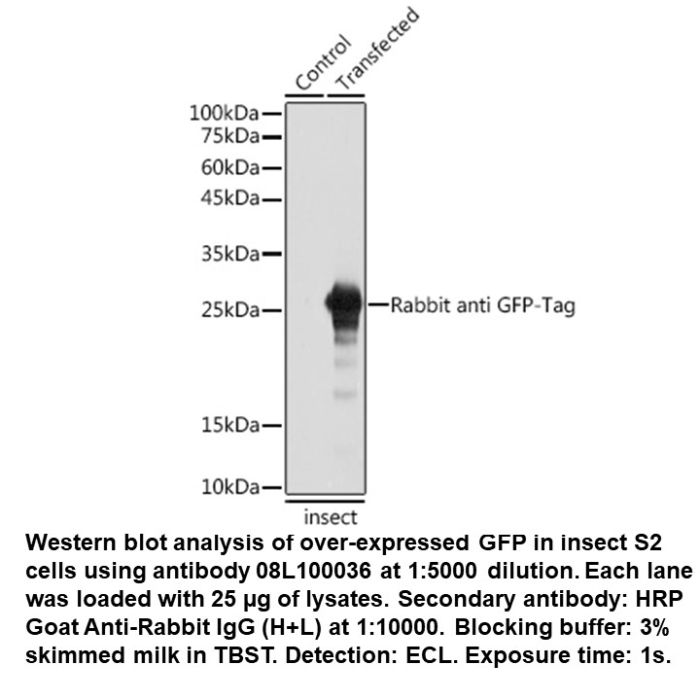
MP Biomedicals Rabbit anti-GFP-Tag monoclonal antibody offers high specificity and potency and consistency against GFP tag, which has been experimentally validated in Western blotting (WB) and Immunofluorescence (IF) assays.
Usage Statement
Research use only, not for direct human use.
Key Applications
Western blotting (WB), Immunofluorescence (IF)
Specifications
| SKU | 08L100036 |
| Alternate Names | GFP; GFP tag; GFP-tag |
| Antibody Type | Monoclonal Antibody |
| Applications | Western blotting (WB), Immunofluorescence (IF) |
| Background_information | The green fluorescent protein (GFP) is a protein composed of 238 amino acid residues (26.9 kDa) that exhibits bright green fluorescence when exposed to light in the blue to ultraviolet range. Although many other marine organisms have similar green fluorescent proteins, GFP traditionally refers to the protein first isolated from the jellyfish Aequorea victoria. The GFP from A. victoria has a major excitation peak at a wavelength of 395 nm and a minor one at 475 nm. Its emission peak is at 509 nm, which is in the lower green portion of the visible spectrum. The fluorescence quantum yield (QY) of GFP is 0.79. The GFP from the sea pansy (Renilla reniformis) has a single major excitation peak at 498 nm. GFP makes for an excellent tool in many forms of biology due to its ability to form internal chromophore without requiring any accessory cofactors, gene products, or enzymes / substrates other than molecular oxygen.In cell and molecular biology, the GFP gene is frequently used as a reporter of expression. It has been used in modified forms to make biosensors, and many animals have been created that express GFP, which demonstrates a proof of concept that a gene can be expressed throughout a given organism, in selected organs, or in cells of interest. GFP can be introduced into animals or other species through transgenic techniques, and maintained in their genome and that of their offspring. To date, GFP has been expressed in many species, including bacteria, yeasts, fungi, fish and mammals, including in human cells. Scientists Roger Y. Tsien, Osamu Shimomura, and Martin Chalfie were awarded the 2008 Nobel Prize in Chemistry on 10 October 2008 for their discovery and development of the green fluorescent protein. |
| Base Catalog Number | L100036 |
| Bioreactivity | This Rabbit anti-GFP-Tag mAb offers high specificity and potency and consistency against the GFP tag, which has been experimentally validated in Western blotting (WB) and Immunofluorescence (IF) assays. |
| Concentration | Please check the vial’s label |
| Conjugate | Unconjugated |
| Formulation Details | In PBS buffer with 0.02% sodium azide, 0.05% BSA, 50% glycerol, pH7.3-7.4. This antibody can be stored at 2℃-8℃ for one month without detectable loss of activity. This antibody is stable for twelve months from the date of receipt when stored at -20℃ to -80℃. Avoid repeated freeze-thaw cycles. |
| Grade | Molecular Grade |
| Host | Rabbit |
| Immunogen | Immunogen is a full-length recombinant GFP protein. |
| Isotype | IgG |
| Molecular Weight | Observed at 25KDa |
| Pack Size | 100 µL |
| Preparation Method | Affinity purification |
| Solubility | Dissolves in Tris or PBS buffer immediately |
| Specificity | High specificity against antigen tag |
| Storage | -20° |
| Typical Working Concentration | WB: 1:500 - 1:2000; IF: 1:50 - 1:200 |
| Uniprot Number | P42212 |
| Usage Statement | Research use only, not for direct human use. |
Documents
Certificate of Analysis (COA)
![MP COA [08L100036R] lot ID: U1124073906](https://www.mpbio.com/static/version1792757118/frontend/Mpbio/luma/en_US/images/document.png "MP COA [08L100036R] lot ID: U1124073906")
Datasheet
Datasheet
English (United States)
Brochures
Brochures
English (United States)
 Powered by Bioz