
How clean do you need it to be
The optimal cleaning products for your application depend on cleanliness requirements. In some cases, simply removing the soil or oils is sufficient, whereas sterilization may be required in other situations where sample contamination, or bacterial growth, is of high concern.
The level of cleanliness needed depends on the piece of equipment, application, environment, and any regulatory guidelines—such as those associated with cGMP and critical cleaning.
What pH should you use
Detergents vary in pH, which can dictate how abrasive it is and what types of soils it can effectively remove. Understanding the type of soil(s) you need to remove is important to selecting the ideal detergent.
Near-neutral detergents, such as the 7XTM Cleaning Solutions, are versatile and can effectively remove numerous types of soils—from adhesives to blood—without corroding or etching the surface being cleaned. Neutral detergents are also beneficial because they are gentle on the hands and you can avoid neutralizing rinse steps.
To tackle certain soil types, you may need more alkaline or acidic cleaning products. Alkaline cleaners are suitable for organic soils such as oils and grease. Acidic cleaners work well on inorganic soils such as metals and salts.
The ideal detergent will maintain its pH upon dilution, making it convenient to work with.
Pro Tips:
7XTM can be used from 1% to 7% final concentration. For example, each gallon of 7XTM Cleaning Solution makes up to 128 gallons of 1% working solution, or 36 gallons of 2.8% working solution. Simply add purified water to the 7XTM concentrate to prepare the finished detergent. No mixing or pH adjustment is necessary!
What surface needs to be cleaned
Are you cleaning stainless steel, glass, plastics, ceramics, or filter membranes?
The detergent you select must be compatible with the surface, or machine, you are cleaning to avoid damaging the equipment. A detergent with a neutral pH may be needed for sensitive surfaces, such as soft metals and filter membranes.
Which cleaning method are you using?
Common methods for cleaning laboratory equipment include machine washing, manual (hand washing), soaking, ultrasonic washing, and clean in place. Cleaning products come in different forms and formulations, making them ideal for specific cleaning methods. For instance, low-foaming liquid detergents, such as ES 7X-O-Matic Cleaning Solution, are ideal for laboratory dishwashers.
Is the detergent safe?
Many detergents can be effective for the same soil, surface, and method. Ideally, the cleaning detergent will be free of hazardous compounds to reduce the environmental impact.
Consider using detergents that are environmentally safe (ES), such as MP Bio’s ES 7XTM Cleaning Solutions, which are available as a concentrate, a ready-to-use option, and even for machine use.
Environmentally safe detergents are completely free of phosphate and are biodegradable, so you can feel good using your ES cleaning solutions.
Check if it works
Prior to using a new detergent in your cleaning process, assess if any residual detergent remains on a small surface by using a Hach test, UV-vis spectroscopy, or attenuated total reflection FTIR (ATR-FTIR) Read How.
Consider doing a quick test to determine if the detergent removes the soil. For instance, you can use scanning electron microscopy (SEM) to investigate whether a cleaning solution can effectively remove bacterial and microbial debris adhered to glass covers.
When in doubt, ask the manufacturer about the compatibility of their detergent with the soil, surface, and method.
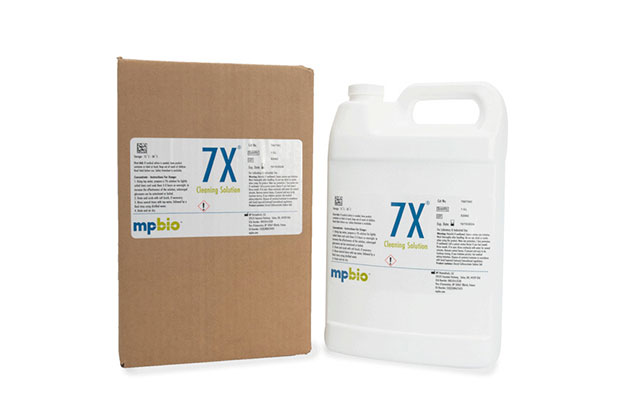
7X Cleaning Solution
From every day benchtop use to large-scale industrial and manufacturing needs, keep your lab free from contaminants with our industry-standard cleaning solution.
View Product