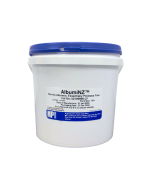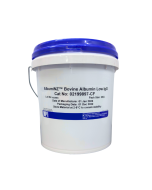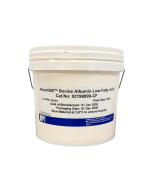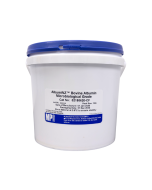
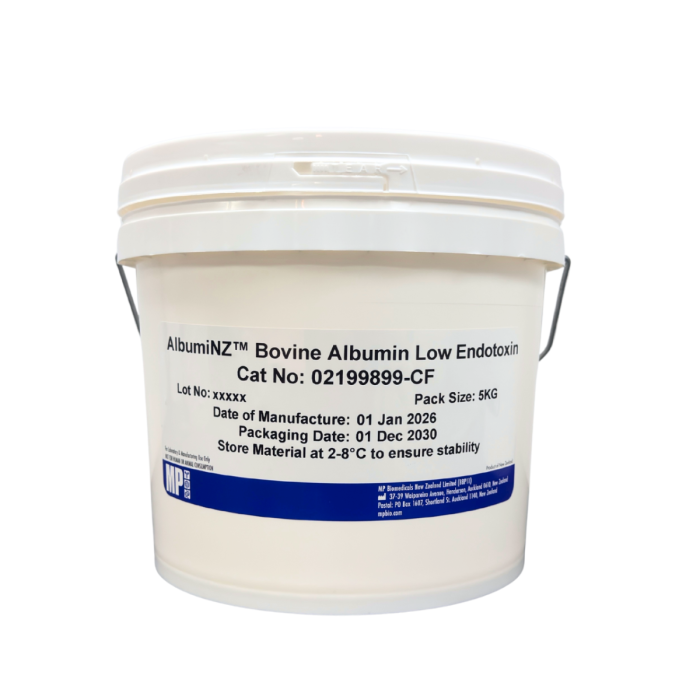
AlbumiNZ™ Bovine Albumin Low Endotoxin, ≥97%
SKU: 02199896-CF
AlbumiNZ™ Low Endotoxin BSA from MP Biomedicals is a high-purity (≥97%) bovine serum albumin sourced from New Zealand bovine plasma. Designed for research workflows where endotoxin control matters, this stem cell-grade albumin is suitable for evaluation as a supplement in cell and tissue culture media and as a carrier protein in serum-free formulations. Explore the manufacturer’s BSA Selection Guide and review the current lot-specific Certificate of Analysis to select the appropriate albumin grade.
Application Notes
Albumin binds water, Ca2+, Na+, and K+. Due to a hydrophobic cleft, albumin binds fatty acids, bilirubin, hormones and drugs. The main biological function of albumin is to regulate the colloidal osmotic pressure of blood and to a lesser degree to provide cellular nutrition. Bovine albumin contains 16% nitrogen and is often used as a standard in protein calibration studies. Albumin is used to solubilize lipids, stabilize protein solutions, and is also used as a blocking agent in Western blots or ELISA applications.
Usage Statement
Unless specified otherwise, MP Biomedical's products are for research or further manufacturing use only, not for direct human use. For more information, please contact our customer service department.
Key Applications
Stem cell research | Cell Culture applications | Immunoassay
| SKU | 02199896-CF |
| Applications | Stem cell research | Cell Culture applications | Immunoassay |
| Application Notes | Albumin binds water, Ca2+, Na+, and K+. Due to a hydrophobic cleft, albumin binds fatty acids, bilirubin, hormones and drugs. The main biological function of albumin is to regulate the colloidal osmotic pressure of blood and to a lesser degree to provide cellular nutrition. Bovine albumin contains 16% nitrogen and is often used as a standard in protein calibration studies. Albumin is used to solubilize lipids, stabilize protein solutions, and is also used as a blocking agent in Western blots or ELISA applications. |
| Background_information | Albumins are a group of acidic proteins which occur in the body fluids and tissues of mammals and in some plant seeds. Serum and plasma albumin is carbohydrate-free and comprises 55-62% of the protein present. However, only about 40% of the total albumin in the body is in the circulating plasma at one time with the remainder being in extracellular spaces with which there is, in general, equilibration about every 24 hours. |
| Base Catalog Number | 199896 |
| Biochemical Physiological Actions | Albumin loses its helical structure rapidly in 2-4 M urea and 4 M guanidinium chloride. The unfolding is reversible, even, to some extent, after concomitant reduction of all disulfide bonds . Reduced albumin can reform into structures capable of binding antibodies and other ligands . Formation of SS bonds is rapid but the return of native structure is slow and some wrong disulfide pairings may persist . After oxidation of the cystine bridges, however, native structure is irreversibly lost. |
| CAS # | 9048-46-8 |
| Concentration | Total Protein: ≥95% |
| EC Number | 232-936-2 |
| Format | Lyophilized powder |
| Grade | Cell Culture Grade, ImmunoAssay (EIA) Grade |
| Host | Bovine |
| Molecular Weight | 66KDa |
| pH | 6.5 - 7.5 (4% aq soln) |
| Protein or Enzyme Type | Albumin |
| Purity | ≥97% Total Protein |
| Solubility | Albumins are readily soluble in water and can only be precipitated by high concentrations of neutral salts such as ammonium sulfate. The solution stability of albumin is very good (especially if the solutions are stored aliquoted and frozen). Albumin is readily coagulated by heat. When heated to 50 °C or above, albumin quite rapidly forms hydrophobic aggregates which do not revert to monomers upon cooling. Dissolves completely in 20 min at 20-25 °C (20%). |
| Usage Statement | Unless specified otherwise, MP Biomedical's products are for research or further manufacturing use only, not for direct human use. For more information, please contact our customer service department. |
Frequently Asked Questions
What is the difference between Low Endotoxin BSA and Low IgG BSA?
Low Endotoxin BSA prioritizes an endotoxin specification. AlbumiNZ Low IgG BSA (Catalog #199897) is a separate grade designed for work where residual IgG may interfere. Select the grade based on your experiment’s main critical quality attribute.
How is Low Endotoxin BSA different from Low Free Fatty Acid BSA?
AlbumiNZ Low Free Fatty Acid BSA (Catalog #199899) is designed for applications where fatty-acid content is a key consideration. Low Endotoxin BSA (Catalog #199896) instead emphasizes endotoxin control. These labels are not interchangeable.
Can Low Endotoxin BSA be used in ELISA or Western blotting?
BSA is frequently used as a protein blocker or stabilizer in immunoassay research. However, if immunoglobulin contamination, enzyme activity or assay background is critical, consider MP Biomedicals’ corresponding Low IgG or Protease-Reduced BSA grades.
What is the molecular weight and purity of AlbumiNZ Low Endotoxin BSA?
The MP Biomedicals product page identifies an approximate molecular weight of 66 kDa and purity of ≥97% for Catalog #199896. Refer to the latest approved specification and lot CoA for controlled release values.
What is AlbumiNZ BSA made from?
AlbumiNZ Low Endotoxin BSA is sourced from bovine plasma collected in New Zealand. It is animal-derived, so it should not be described as xeno-free or animal-origin-free.
How should AlbumiNZ Low Endotoxin BSA be prepared and stored?
Preparation and storage must follow the current manufacturer label, datasheet and applicable lot documentation. The public PDP describes water solubility; do not apply an arbitrary universal working concentration or storage condition to every protocol.
Where can I find lot-specific quality documentation for Catalog #199896?
Use the MP Biomedicals product page to access the Certificate of Analysis, product datasheet and Safety Data Sheet, and review the BSA Selection Guide for comparisons across albumin grades.

 Powered by Bioz