Online ordering is not available in Latin America

Getting the Most Out of Forensic Samples for STR Analysis
Have you ever seen movies where investigators effortlessly collect DNA samples from a crime scene, run it through a machine, and get a complete profile back in minutes? The reality of forensic science is often far less cinematic. Instead, forensic analysts routinely face the challenge of low-recovery samples such as touch DNA, faded bloodstains, degraded hair, or aged bones. These low-template samples are common due to real-world factors like environmental exposure, UV damage, and the inherent scarcity of trace evidence. For Short Tandem Repeat (STR) analysis, the quality and quantity of DNA recovered are crucial. Getting as much usable DNA as possible can mean the difference between a clear profile and one that isn’t reliable.
What Makes a Sample “Low-Recovery”?
Insufficient Biological Input
This is the most straightforward challenge: the DNA simply isn't there in large amounts. Classic examples of low-biological input include touch DNA, hair shafts, minute dried stains, or microscopic traces of saliva. In these scenarios, the total recoverable DNA may be below the stochastic threshold for conventional STR testing, making reliable profiling highly dependent on the efficiency of the extraction method [1].
DNA Degradation and Inhibitors
DNA is vulnerable to fragmentation and damage when exposed to time, heat, UV light, moisture, and microbial activity. These factors break the DNA backbone into shorter fragments, which disproportionately affects larger STR loci and increases the risk of allele drop-out, especially for conventional STR panels targeting longer amplicons [2]. Degraded material therefore often produces partial or imbalanced profiles, and successful STR analysis depends on extraction methods that can efficiently recover and preserve even fragmented DNA.
Difficult Substrates
The physical matrix containing DNA can actively hinder recovery. Substrates with high binding affinities or complex structures make it difficult to get DNA into solution for purification. These include:
-
Porous and Fibrous Materials: Paper, cloth, wood. [3] [4]
Dense or Calcified Tissue: Bone and teeth require extensive pre-processing and decalcification steps to release trapped DNA. [5]
Using
FastPrep-24™ 5Gwith appropriate lysing matrix tubes supports thorough mechanical disruption of the layer, improving DNA release.
How good DNA Extraction Improves STR Results
Better Peak Clarity and Reduced Drop-Out
The goal of DNA extraction is to isolate clean, intact DNA. When the DNA is pure and free of contaminants, it improves the downstream STR amplification’s profile completeness and reduces dropouts [6].
-
Clean DNA represents more complete allele representation: A high-quality extraction ensures that the target DNA sequences are available in the necessary quantity and condition for PCR. This results in sharp, clear peaks on the electropherogram, representing the alleles present in the sample.
-
Reduced Drop-Out: When the extraction is poor, or the DNA is degraded, some alleles might fail to amplify, leading to allele drop-out. In criminal casework, missing alleles can render a profile unusable for identification or database matching. This is especially essential for complex or trace samples like tooth powder or fingerprint tape.
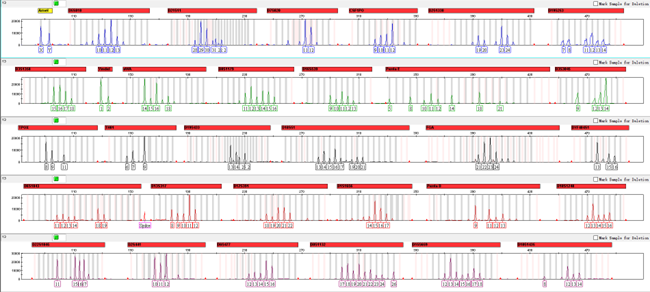
Figure 1. STR profile obtained from a pooled blood stain sample using the SPINeasy® DNA Kit for Forensics. All loci display strong, well-resolved peaks, with multiple alleles detected at most loci due to the mixed-donor origin of the sample. The complete and balanced peak patterns indicate efficient recovery of high-quality nuclear DNA from blood and demonstrate the kit’s suitability for STR analysis of mixed-source biological samples.
Reduced Inhibition Boosts Amplification Efficiency
Substances such as hemoglobin, immunoglobulin G, humic acids, and certain reaction additives can act as PCR inhibitors by reducing DNA polymerase activity [7], interacting with the DNA template, or suppressing fluorescence readout, which diminishes amplification efficiency and may lead to false‑negative results or allele drop‑out.
How Inhibitors Block PCR: When inhibitors are present, they directly compete with the DNA template or interfere with the polymerase enzyme, drastically reducing the efficiency of the amplification cycle [8]. This results in faint peaks and imbalanced signal strength across the profile.
The SPINeasy® Advantage: Superior extraction protocols excel at removing these inhibitory substances. SPINeasy® DNA Kit for Forensics shows no inhibition in downstream PCR and STR analysis. This helps ensure that the maximum potential of the recovered DNA is extracted during the amplification stage.
Improved Recovery of Both Nuclear and Mitochondrial DNA
A good extraction method is designed to maximize the recovery of all available DNA, including both gDNA (gDNA) and mitochondrial DNA (mtDNA), which is valuable in highly compromised samples like ancient bones or hair shafts.
-
Maximizing Usable Profiles: Even when the amount of gDNA is critically low, a high-efficiency extraction significantly increases the chance of generating a usable STR profile. Higher initial recovery means more template DNA is available, raising the probability of a successful profile even if some degradation or partial inhibition is still present.
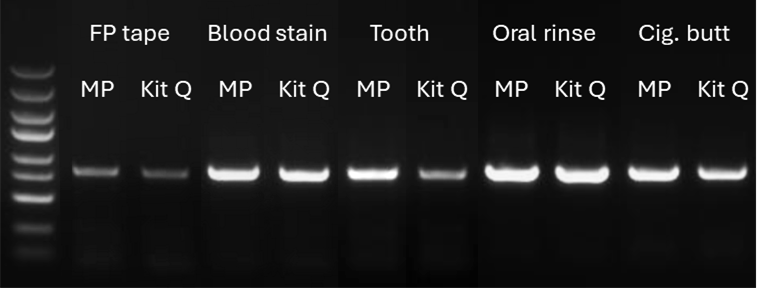
Figure 2. Long-fragment PCR of the mitochondrial CO1 gene (827 bp) shows that DNA extracted with the SPINeasy® Forensics Kit yields stronger, cleaner amplification bands than a leading competitor across multiple forensic sample types, highlighting improved recovery of high-quality mtDNA for downstream analysis.
More Reliable Multiplex Amplification Across All Loci
Modern forensic analysis uses multiplex PCR, simultaneously amplifying 20 or more STR markers (loci) in a single reaction [9]. For a profile to be useful, it must be complete, meaning all targeted loci must successfully amplify.
-
Complete STR profiles are required for reliable human identification and successful database matching. Profiles with missing or partial loci can only be used for exclusion, not inclusion, which severely limits their forensic value [9].
-
Proof in the Profile: The quality of the extraction directly impacts the balance of the multiplex reaction. The SPINeasy® DNA kit for Forensics demonstrates its strength by showing more complete STR profiles from difficult samples. This showcases how efficient inhibitor removal and high DNA recovery lead to balanced amplification across all loci, providing the complete genetic fingerprint required for definitive identification.
Conclusion
Achieving complete, balanced STR profiles across all loci is essential for definitive forensic identification. This depends on both robust multiplex PCR systems and high-quality DNA extraction that efficiently removes inhibitors and maximizes DNA yield. As forensic science continues to evolve, adopting these best practices ensures each sample’s potential is fully realized for confident human identification and case resolution.
Unlock the full potential of your forensic samples and achieve definitive, actionable genetic profiles.
Reference
Tozzo, P., Mazzobel, E., Marcante, B., Delicati, A., & Caenazzo, L. (2022). Touch DNA sampling Methods: Efficacy evaluation and systematic review. International Journal of Molecular Sciences, 23(24), 15541. https://doi.org/10.3390/ijms232415541
Bhoyar, L., Mehar, P., & Chavali, K. (2024). An overview of DNA degradation and its implications in forensic caseworks. Egyptian Journal of Forensic Sciences, 14(1). https://doi.org/10.1186/s41935-024-00389-y
Rana, A. K. (2025c). Challenging biological samples and strategies for DNA extraction. Journal of Investigative Medicine, 73(6), 443–459. https://doi.org/10.1177/10815589251327503
Thompson, J. (n.d.). Comparing Five Forensic DNA Extraction Methods. http://www.uniscience.co.kr/ZyGEM/Comparing%20Five%20Forensic%20DNA%20Extraction%20Methods.pdf
Samsuwan, J., Somboonchokepisal, T., Akaraputtiporn, T., Srimuang, T., Phuengsukdaeng, P., Suwannarat, A., Mutirangura, A., & Kitkumthorn, N. (2018). A method for extracting DNA from hard tissues for use in forensic identification. Biomedical Reports, 9(5), 433–438. https://doi.org/10.3892/br.2018.1148
Putkonen, M. T., Palo, J. U., Cano, J. M., Hedman, M., & Sajantila, A. (2010). Factors affecting the STR amplification success in poorly preserved bone samples. Investigative Genetics, 1(1), 9. https://doi.org/10.1186/2041-2223-1-9
Funes‐Huacca, M. E., Opel, K., Thompson, R., & McCord, B. R. (2011). A comparison of the effects of PCR inhibition in quantitative PCR and forensic STR analysis. Electrophoresis, 32(9), 1084–1089. https://doi.org/10.1002/elps.201000584
Kuffel, A., Gray, A., & Daéid, N. (2020). Impact of metal ions on PCR inhibition and RT-PCR efficiency. International Journal of Legal Medicine, 135, 63 - 72. https://doi.org/10.1007/s00414-020-02363-4.
Mahmoud¹, O., Hameed¹, M., Muhi¹, S., Abd¹, F., Ibrahim¹, S., Hadi¹, I., Abdullah, D., Ruaa, M., & MaanAttallah, ¹. (2025). Advancements and Applications of STR Kits in Forensic DNA Profiling: A Comprehensive Review. Baghdad Journal of Biochemistry and Applied Biological Sciences. https://doi.org/10.47419/bjbabs.v6i.355