

Reliably Lyse Your Cells and Tissues to Get the RNA You Need
Below are recipes to help you prepare your RNA extraction buffers and reagents. Typically, you’ll need to use mechanical or enzymatic shearing to speed up the process and avoid RNA degradation, but the reagents and materials you need depends on your specific project.
If you’re just getting started on RNA extraction, read our Guide to RNA Extraction.
You can find all of the RNA extraction reagents mentioned here at MP Bio. Additionally, you can explore our lysing matrices, RNA isolation kits, and ready-to-use RNA extraction buffers—available for virtually any sample type.
Use Acid-Guanidium-Phenol Extraction for Cells and Tissues
This method is useful for extracting total RNA or viral RNA, however it is generally unsuitable for purifying short RNAs such as siRNA, miRNA, gRNA, and tRNA.
This is a liquid-liquid extraction technique that relies on phase separation of an aqueous sample mixed with a phenol-chloroform solution. Using guanidium thiocyanate, nucleic acids partition into the aqueous phase and proteins partition into the organic phenol phase. Using acidic conditions (pH 4-6), you can push DNA into the organic phase while retaining RNA in the aqueous phase (under neutral conditions, both DNA and RNA partition into the aqueous phase).
The basic steps of this method include (reagents and recipes in the table below):
- Homogenize cells using cell lysis solution (and lysing matrix if needed)
- Transfer the homogenate to a fresh tube and add sodium acetate, water-saturated phenol, chloroform/isoamyl alcohol or bromochloropropane—mixing after each addition—and incubating at a cool temperature
- Centrifuge, and transfer the upper aqueous phase (this contains your RNA!) to a fresh tube
- Precipitate, wash, and resuspend the RNA
RNA Extraction Reagents and Recipes
Reagents and Recipes for Acid-Guanidium-Phenol RNA Extraction
|
Step 1 Reagents and Recipes |
|
|
Cell Lysis Solution Final Concentration |
|
|
Stock solution |
Store up to 3 months at room temperature |
|
Working solution (50 mL) |
|
|
Step 2 Reagents and Recipes |
|
|
2 M sodium acetate, pH 4 |
Store up to 1 year at room temperature |
|
Water-saturated phenol |
Store up to 1 month at 4°C. Do not use buffered phenol in place of water-saturated phenol. |
|
49:1 (v/v) chloroform/isoamyl alcohol (or bromochloropropane) |
|
|
Step 3 Reagents and Recipes |
|
|
Centrifuge and transfer aqueous phase to a new tube—no reagents necessary |
|
|
Step 4 Reagents and Recipes |
|
|
Precipitation: 100% isopropanol |
|
|
Wash: 75% ethanol |
To 1 liter of 95% alcohol, add 294 ml DEPC water |
|
Resuspension: DEPC-treated water |
|
RNA Extraction in Practice
A variety of methods exist for extracting RNA and the equipment and RNA extraction reagents you need will depend on your sample type, the type of RNA you are aiming to isolate, and your downstream application.
Read more about how Acid-Guanidium-Phenol Extraction works and how research groups are tailoring it to their specific needs:
- Chomczynski, Piotr, and Nicoletta Sacchi. "The single-step method of RNA isolation by acid guanidinium thiocyanate–phenol–chloroform extraction: twenty-something years on." Nature protocols 1.2 (2006): 581-585.
- Toni, Lee S., et al. "Optimization of phenol-chloroform RNA extraction." MethodsX 5 (2018): 599-608.
- Torii, Shotaro, Hiroaki Furumai, and Hiroyuki Katayama. "Applicability of polyethylene glycol precipitation followed by acid guanidinium thiocyanate-phenol-chloroform extraction for the detection of SARS-CoV-2 RNA from municipal wastewater." Science of The Total Environment 756 (2021): 143067.
- Zavala-Alvarado, Crispin, and Nadia Benaroudj. "The Single-Step Method of RNA Purification Applied to Leptospira." Leptospira spp.. Humana, New York, NY, 2020. 41-51.
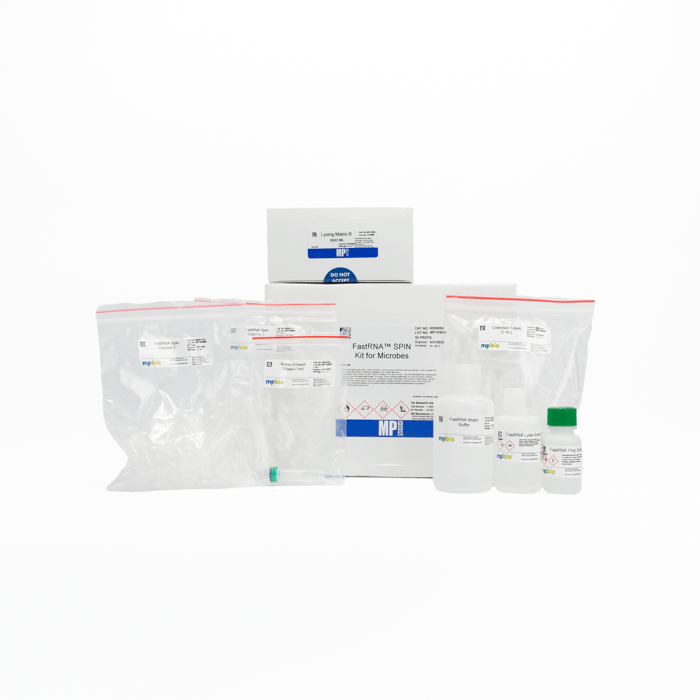
FastRNA SPIN Kit for Microbes, 50 preps
Efficiently isolate high-quality total RNA from tough-to-lyse bacterial cell cultures and other microbial sources.
View Product