
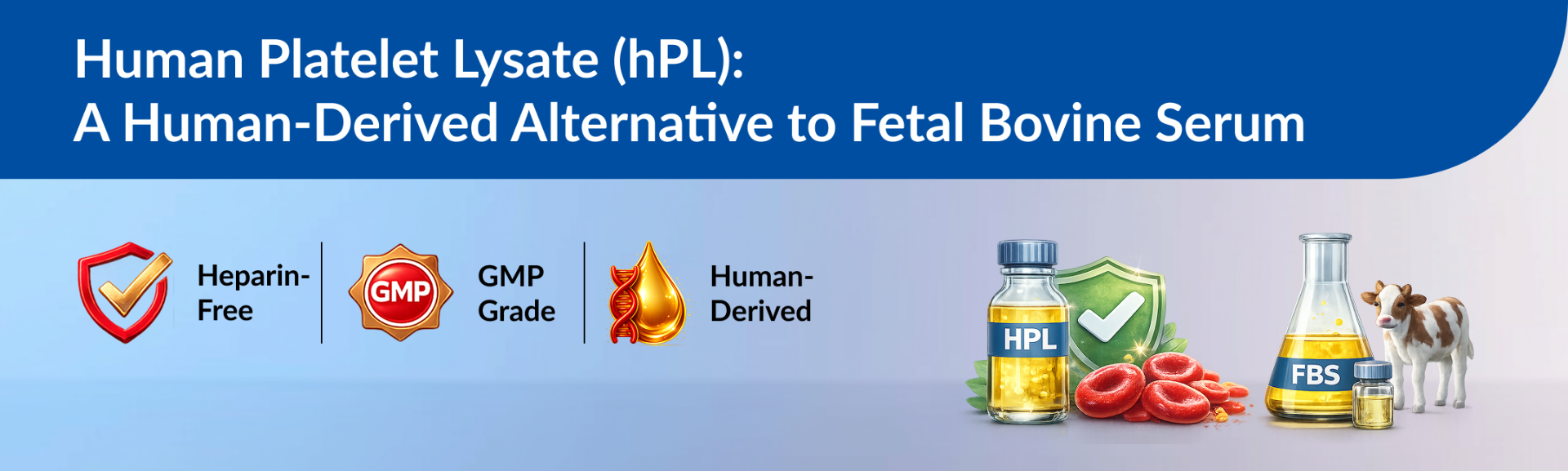
Demand is growing for cell culture supplements that are safer, more consistent, and free of animal-derived components. In both academic research and clinical manufacturing, fetal bovine serum (FBS), long considered the standard supplement for cell expansion, is increasingly being replaced by human-derived alternatives. Among these alternatives, human platelet lysate (hPL) has emerged as a strong option because it is rich in growth factors and well suited to human cell culture.
More recent hPL formulations include heparin-free, GMP-grade options designed to support animal component–free workflows in translational applications. This development supports safer workflow design, stronger regulatory compliance, and improved batch-to-batch consistency for scalable bioproduction.
What Is Human Platelet Lysate?
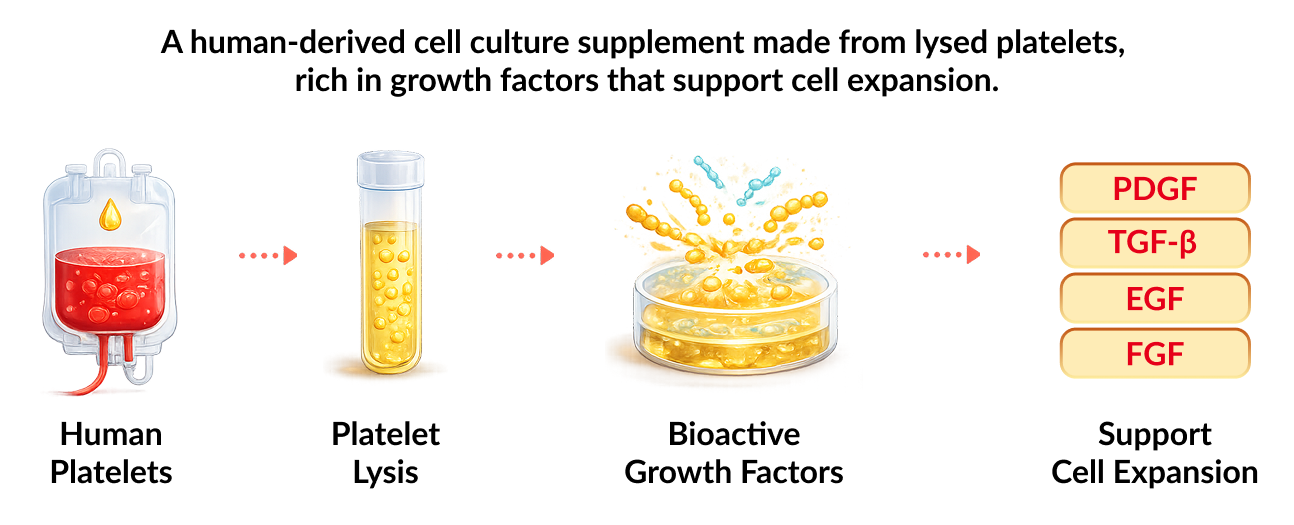
Human Platelet Lysate (hPL) is a cell culture supplement produced from platelet-rich plasma (PRP), collected from screened human donors. During processing, platelets are lysed to release a rich mix of growth-promoting biomolecules, including platelet-derived growth factor (PDGF), transforming growth factor-beta (TGF-β), epidermal growth factor (EGF), and basic fibroblast growth factor (bFGF). [1]
These signaling molecules support important cellular activities such as proliferation, adhesion, and differentiation, making hPL useful for culturing primary human cells such as mesenchymal stromal cells (MSCs), immune cells, and endothelial cells.
Compared with FBS, hPL reduces species- related concerns and provides a more physiologically relevant environment for human cells. This can support strong cell growth, morphology maintenance, and reproducibility across experiments and manufacturing runs.
Heparin-Free hPL and Xeno-Free Culture
hPL naturally contains fibrinogen and coagulation factors from platelet-rich plasma. When added to calcium-containing basal media, these components can trigger fibrin polymerization, forming gels or clots that make the medium unusable. Heparin‑free human platelet lysate (hPL) is a fibrinogen‑depleted form of hPL that no longer requires the heparin to prevent clot or gel formation in culture medium, while still supporting robust cell expansion. [2]
Key advantages of Heparin-free hPL
-
Regulator alignment: Fully human composition removes animal-derived components.
-
Improved workflow consistency: No heparin simplifies media formulation and supports more consistent process design across batches.
-
Improved safety profile: Removes the need for porcine-derived heparin and avoids associated animal-derived concerns.
-
Simplified workflows: Ready to use, with no heparin titration required.

Why GMP-Grade Production Matters
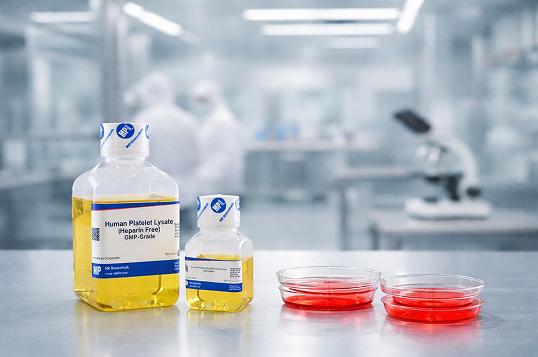
“GMP-grade” refers to Good Manufacturing Practice, a quality framework used in the production of materials intended for use in clinical or therapeutic workflows. For hPL, GMP manufacturing is intended to support:
Fully traceable human donor material collected through qualified blood banksystems.
Sterile, closed-system processing help minimize contamination risk.
Strict quality control, including sterility, endotoxin, mycoplasma, and viral testing.
Defined specifications for protein content, osmolality, and pH.
Documentation that can support regulatory review and clinical workflow qualification.
These measures help distinguish GMP-grade hPL from research-grade alternatives. While both may perform similarly in cell growth assays, GMP-grade production provides the documentation and manufacturing controls needed for integration into cell therapy manufacturing pipelines, GMP-compliant labs, and regulated bioproduction environments.
Applications in Research and Biomanufacturing
Heparin-free, GMP-grade hPL is suited for a wide range of applications where safety, reproducibility, and regulatory alignment are high priorities:
Mesenchymal stromal cell (MSC) expansion: Supports strong proliferation and viability without animal-derived growth factors. [3]
Immune cell manufacturing: Supports the growth of dendritic cells, NK cells, and CAR-T-related cells for immunotherapy pipelines. [4]
Tissue engineering and regenerative medicine: Supports human-derived scaffold seeding and organoid models. [5]
Extracellular vesicle and exosome production: Supports human-source vesicle production without bovine-derived contaminants. [6]
hPL vs FBS at a Glance
FBS | hPL | |
| Source | Bovine fetus blood | PRP from screened donors |
| Xeno‑free | No | Can be xeno-free, depending on formulation |
| Growth factors | Undefined bovine mix | High levels of human PDGF, TGF‑β, EGF, bFGF |
| MSC proliferation | Doubling Time: >40 hrs | Often reported to support faster proliferation than FBS |
| Batch variability | Very high | Reduced through donor pooling, but batch qualification is still important |
| Safety risks | BSE, viruses, immune reactions | Avoids bovine-derived risks but still requires donor screening and quality testing |
| Regulatory | Common in research use | Available in GMP-grade formats for regulated workflows |
| Concentration | 10% | 5% |
| Ethical concerns | High | Low |
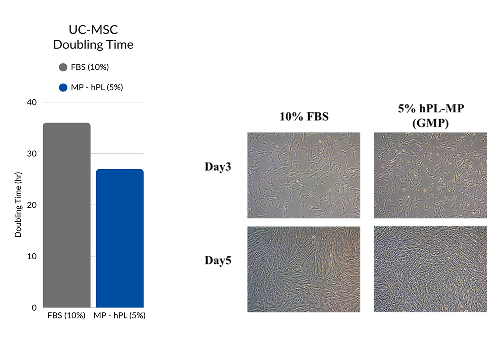
Compared with 10% FBS, the 5% hPL-MP (GMP Grade) supported improved hUC-MSC culture performance, with faster doubling time, higher cell density, more uniform fibroblast-like morphology, and more cohesive monolayer formation.
These findings demonstrate the strong potential of hPL-MP as an effective supplement for robust and consistent hUC-MSC expansion.
A Better Foundation for Modern Cell Culture
The shift toward human-derived, xeno-free culture systems marks an important step in biotechnology and regenerative medicine. Heparin-free, GMP-grade hPL offers researchers and manufacturers a more practical, ethically aligned option for high-performance cell culture.
By removing the need for porcine-derived heparin and supporting GMP-based manufacturing, this next-generation supplement helps organizations scale from bench research into more controlled translational workflows.
For scientists seeking to modernize their workflows, heparin-free hPL can provide a stronger foundation for consistent success in cell culture and translational bioproduction.
| Product | Size | Cat. No. |
| Human Platelet Lysate (Heparin Free) | 50 ML | 08810211 |
| 100 ML | 08810212 | |
| 500 ML | 08810213 | |
| Human Platelet Lysate (Heparin Free), GMP Grade | 50 ML | 08810251 |
| 100 ML | 08810252 | |
| 500 ML | 08810253 |
Ready to explore heparin-free, GMP-grade human platelet lysate?
For cell culture workflows that require a human-derived, animal component-free supplement, choosing a heparin-free, GMP-grade hPL can support greater process consistency, simplified media preparation, and better alignment with translational and manufacturing needs.
References
1. Palombella S, Guiotto M, Higgins GC, Applegate LL, Raffoul W, Cherubino M, Hart A, Riehle MO, di Summa PG. Human platelet lysate as a potential clinical-translatable supplement to support the neurotrophic properties of human adipose-derived stem cells. Stem Cell Res Ther. 2020 Oct 6;11(1):432. doi: 10.1186/s13287-020-01949-4. PMID: 33023632; PMCID: PMC7537973.
2. Kee LT, Lee YT, Ng CY, Hassan MNF, Ng MH, Mahmood Z, Abdul Aziz S, Law JX. Preparation of Fibrinogen-Depleted Human Platelet Lysate to Support Heparin-Free Expansion of Umbilical Cord-Derived Mesenchymal Stem Cells. Biology (Basel). 2023 Aug 3;12(8):1085. doi: 10.3390/biology12081085. PMID: 37626970; PMCID: PMC10452143.
3. Capelli C, Domenghini M, Borleri G, Bellavita P, Poma R, Carobbio A, Micò C, Rambaldi A, Golay J, Introna M. Human platelet lysate allows expansion and clinical grade production of mesenchymal stromal cells from small samples of bone marrow aspirates or marrow filter washouts. Bone Marrow Transplant. 2007 Oct;40(8):785-91. doi: 10.1038/sj.bmt.1705798. Epub 2007 Aug 6. PMID: 17680021.
4. Immalaraju S, Goyal S, Jonnalagadda R. Towards the standardization of human platelet lysate production and its comparison to fetal bovine serum for human hematopoietic cell culture: a scoping review. Front Toxicol. 2025 Jun 27; 7:1496231. doi: 10.3389/ftox.2025.1496231. PMID: 40655131; PMCID: PMC12245862.
5. Bordin A, Chirivì M, Pagano F, Milan M, Iuliano M, Scaccia E, Fortunato O, Mangino G, Dhori X, De Marinis E, D'Amico A, Miglietta S, Picchio V, Rizzi R, Romeo G, Pulcinelli F, Chimenti I, Frati G, De Falco E. Human platelet lysate-derived extracellular vesicles enhance angiogenesis through miR-126. Cell Prolif. 2022 Nov;55(11):e13312. doi: 10.1111/cpr.13312. Epub 2022 Aug 9. PMID: 35946052; PMCID: PMC9628251.
6. Bordin A, Chirivì M, Pagano F, Milan M, Iuliano M, Scaccia E, Fortunato O, Mangino G, Dhori X, De Marinis E, D'Amico A, Miglietta S, Picchio V, Rizzi R, Romeo G, Pulcinelli F, Chimenti I, Frati G, De Falco E. Human platelet lysate-derived extracellular vesicles enhance angiogenesis through miR-126. Cell Prolif. 2022 Nov;55(11):e13312. doi: 10.1111/cpr.13312. Epub 2022 Aug 9. PMID: 35946052; PMCID: PMC9628251.